Copyright © 2026 Woodvalley Vineyards Ltd

Sponsored by Alden Rose, Billericay
www.aldenrose.co.uk
Low Energy Building Design

Members of WineGB

The Great British Vineyard Guide


Cellar Door
September Opening Times:
Thursday -
Sunday 10am -
Please phone for other times
07926 474711
Find Us
Woodvalley Vineyards Ltd
Woodvalley Farm
Outwood Common Road
Billericay, Essex CM11 1ET
W3W: stand.pull.deck
T: 07926 474711
E: info@woodvalleyvineyards.co.uk



Wine Geekery -
Know Your Wine Jargon:
Part 4: A Deeper Guide to Tasting Notes
So, you’ve mastered your fruity notes, know your mouthfeel from your minerality and can confidently announce that a wine has a “lovely long finish”.
But then someone starts talking about balance, complexity, structure and concentration and suddenly we're back to smiling, nodding and hoping nobody asks us what they actually mean.
Fear not. In Part 4 we're stepping it up a notch and looking at some of the words used to describe the wine as a whole, rather than the individual flavours and aromas inside it.

Here are a few you're likely to come across:
⚖️ Balance – how all the different elements work together.
🧩 Complexity – how much is going on in your glass.
🏗 Structure – the framework holding everything together.
🍇 Concentration – how intense the flavours are.
⏳ Ageing – what happens to a wine over time.
📅 Vintage – much more than just the year printed on the bottle.
⚖️ Balance – Everyone Playing Nicely Together
Wine is made up of several different elements – fruit, acidity, alcohol, sweetness and tannin, depending on the style.
When all of these work together and none of them overwhelms the others, a wine is described as balanced.
Too much alcohol can make a wine feel hot. Too much acidity can make it sharp. Too much sweetness can make it cloying, while too much tannin can leave your mouth feeling like you've just chewed a teabag.
But when everything is in harmony, you probably won't take a sip and think:
“What exceptional balance.”
You'll probably just think:
“Ooh. That's nice.”
Which, in considerably fewer words, means pretty much the same thing.
🧩 Complexity – There’s More Going On
A simple wine might give you one or two obvious flavours from the first sip – perhaps apple, strawberry or blackberry.
A complex wine keeps giving you more.
You might first notice fruit on the nose, then something floral when you taste it. A little spice might appear, followed by something completely different as the flavours linger.
Some of those characteristics may come from the grape itself, while others can develop through fermentation, ageing, oak or time spent on the lees.
Put simply, complexity means there are layers to discover rather than one dominant flavour from beginning to end.
But here's the important bit: Complex doesn't automatically mean you'll like it more.
Sometimes you don't want to contemplate twelve different flavours.
Sometimes you just want a lovely glass of wine.

🏗️ Structure – The Wine’s Invisible Framework
Structure sounds terribly technical, but it's actually quite easy to understand. A wine's structure comes from the relationship between its main components – particularly acidity, tannin, alcohol and sweetness.
These create the framework around which all those lovely fruit, floral and other flavours sit.
A light white wine might have a delicate structure driven mainly by its acidity, while a big red might have a much firmer structure from its tannins and alcohol.
Think of it as the skeleton of the wine. You might not immediately notice it, but it's holding everything else together.
Or, for those of us who can't resist an architectural analogy:
Fruit is the interior design. Structure is the bit stopping the roof falling in. 😂

🍇 Concentration – Turn Up the Volume
Concentration is simply about how intense the flavours in the wine are.
Imagine making a glass of squash. Add far too much water and the flavour becomes thin and weak. Make it stronger and suddenly there's much more flavour in every mouthful.
Wine is obviously a little more complicated than Ribena, but you get the idea.
A concentrated wine has plenty of flavour packed into each sip.
That doesn't necessarily mean it will be heavy, sweet or high in alcohol. A wine can have beautifully intense flavours while still being fresh, light and elegant.
So when you see “concentrated fruit flavours” on a tasting note, think:
The flavour volume has been turned up.
⏳ Ageing – Older Must Mean Better... Right?
Not necessarily.
One of the great wine myths is that every bottle improves if you leave it long enough.
Most wines are actually produced to be enjoyed relatively young, when their fresh fruit flavours are at their best. Two to five years are what are described as “young”.
Some wines, however, have the right combination of acidity, tannin, fruit concentration and structure to develop over many years. As wine ages, those fresh, primary fruit flavours can change and develop into more complex flavours such as dried fruit, nuts, spice, toast, tobacco, leather or earthy notes.
This can be wonderful, but putting an ordinary bottle in the back of a cupboard for twenty years won't magically turn it into a priceless fine wine.
Sometimes you've simply created...a very old bottle of ordinary wine.
📅 Vintage – More Than a Date on the Bottle
The vintage is the year in which the grapes used to make the wine were harvested.
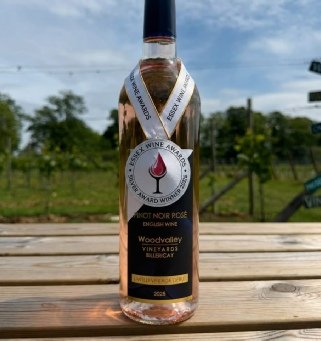
So when you see 2025 on a bottle (like our debut Rosé), it's telling you when those grapes were picked – not when the wine was bottled or when you finally got around to drinking it.
But you'll also hear people talk about a “good vintage”, a “difficult vintage” or an “exceptional vintage”. Here they're talking about the growing season itself. Sunshine, temperature, rainfall and the conditions during ripening and harvest all influence the quality and character of the grapes – and ultimately the wine made from them.
And this is particularly noticeable in England, where Mother Nature has a habit of keeping vineyard owners firmly in their place. One year can be beautifully warm and dry, another full of heatwaves like 2026, another can involve checking the weather forecast approximately every eleven minutes and shouting at clouds.

🍷 So What Actually Makes a Good Wine?
Professionals might look at things such as balance, complexity, concentration, structure and length when assessing the quality of a wine.
They're useful things to understand – and hopefully they now sound considerably less mysterious.
But there's another assessment that's much easier:
Did you enjoy drinking it?
Yes?
Excellent.
Each wine has been produced by a huge team of people from the growers on the ground through to the experts at the winery. Wine is meant to be enjoyed. It doesn’t matter if it is a mass-
And if you can now casually mention its “excellent structure, lovely balance and impressive concentration” while drinking your next glass...
Congratulations. You officially sound like you know what you're talking about.
Cheers from the Four Non-



💷 And Finally... Does Expensive Mean Better?
Not necessarily – and this is where wine gets interesting.
The price of a bottle can reflect all sorts of things: where the grapes were grown, vineyard yields, hand harvesting, production methods, time spent ageing, packaging, taxes, reputation and how much of the wine was actually produced.
So an expensive bottle may be more complex, concentrated or capable of ageing, but none of that guarantees you'll enjoy drinking it more.
A £50 bottle isn't automatically five times more enjoyable than a £10 bottle, and preferring the cheaper one doesn't mean you have an unsophisticated palate.
Wine is ultimately about enjoyment.
So if you prefer the £15 bottle to the £50 one, buy the £15 bottle.
You've now got £35 left to put towards another bottle.
We see absolutely no flaw in this logic.